
Ihr Suchergebnis
Sie recherchieren derzeit unangemeldet.Melden Sie sich an (Login) um den vollen Funktionsumfang der Datenbank nutzen zu können.
In der Rubrik News haben wir 23493 Angebote für Sie gefunden
-
NEUER BEITRAG | Beitrag aus Tech4Pharma 17 | Nr. 3 | Seite 11-23 (2027)
09.09.2027Neue Beiträge von T4P 3-27 hochladen
-
NEUER BEITRAG | Beitrag aus Tech4Pharma 17 | Nr. 2 | Seite 11-23 (2027)
22.04.2027Neue Beiträge von T4P 2-27 hochladen
-
NEUER BEITRAG | Beitrag aus Tech4Pharma 17 | Nr. 1 | Seite 11-23 (2027)
11.03.2027Neue Beiträge von T4P 1-27 hochladen
-
NEUE BEITRÄGE EINSETZEN | Beitrag aus pharmind 88 | Nr. 11 | Seite 374-381 (2026)
30.11.2026Beiträge aus pharmind 11-2026
-
NEUER BEITRAG | Beitrag aus Tech4Pharma 16 | Nr. 4 | Seite 11-23 (2026)
06.11.2026Neue Beiträge von T4P 4-26 hochladen
-
NEUE BEITRÄGE EINSETZEN | Beitrag aus pharmind 88 | Nr. 10 | Seite 374-381 (2026)
30.10.2026Neue Beiträge einsetzen aus PI 10-2026
-

Digitale Produkt- und Prozess-Governance | Beitrag aus Tech4Pharma 16 | Nr. 3 | Seite 164-169 (2026)
30.10.2026Die steigende Variantenvielfalt und die hohen regulatorischen Anforderungen der Pharmaproduktion stellen klassische IT-Landschaften vor grundlegende Herausforderungen. Dieser Fachbeitrag beschreibt eine zentrale digitale Governance-Schicht, die 2 spezifische Lücken schließt: die fehlende Rückverfolgbarkeit vom Electronic Batch Record (EBR) zurück zur freigegebenen Herstellungsanweisung (Master Batch Record, MBR) sowie die auftragsgetriebene dynamische Parametrierung des Manufacturing Execution System (MES) auf Basis von Auftragsattributen – über die statische Produktparametrisierung moderner MES-Systeme hinaus. Änderungen durchlaufen den Good-Manufacturing-Practice(GMP)- Änderungsmanagementprozess. Der Ansatz orientiert sich an ISA-95 und unterstützt die Anforderungen von EU GMP Annex 11 und 21 CFR Part 11.
-
Determination of residual moisture | Beitrag aus pharmind 88 | Nr. 9 | Seite 726-733 (2026)
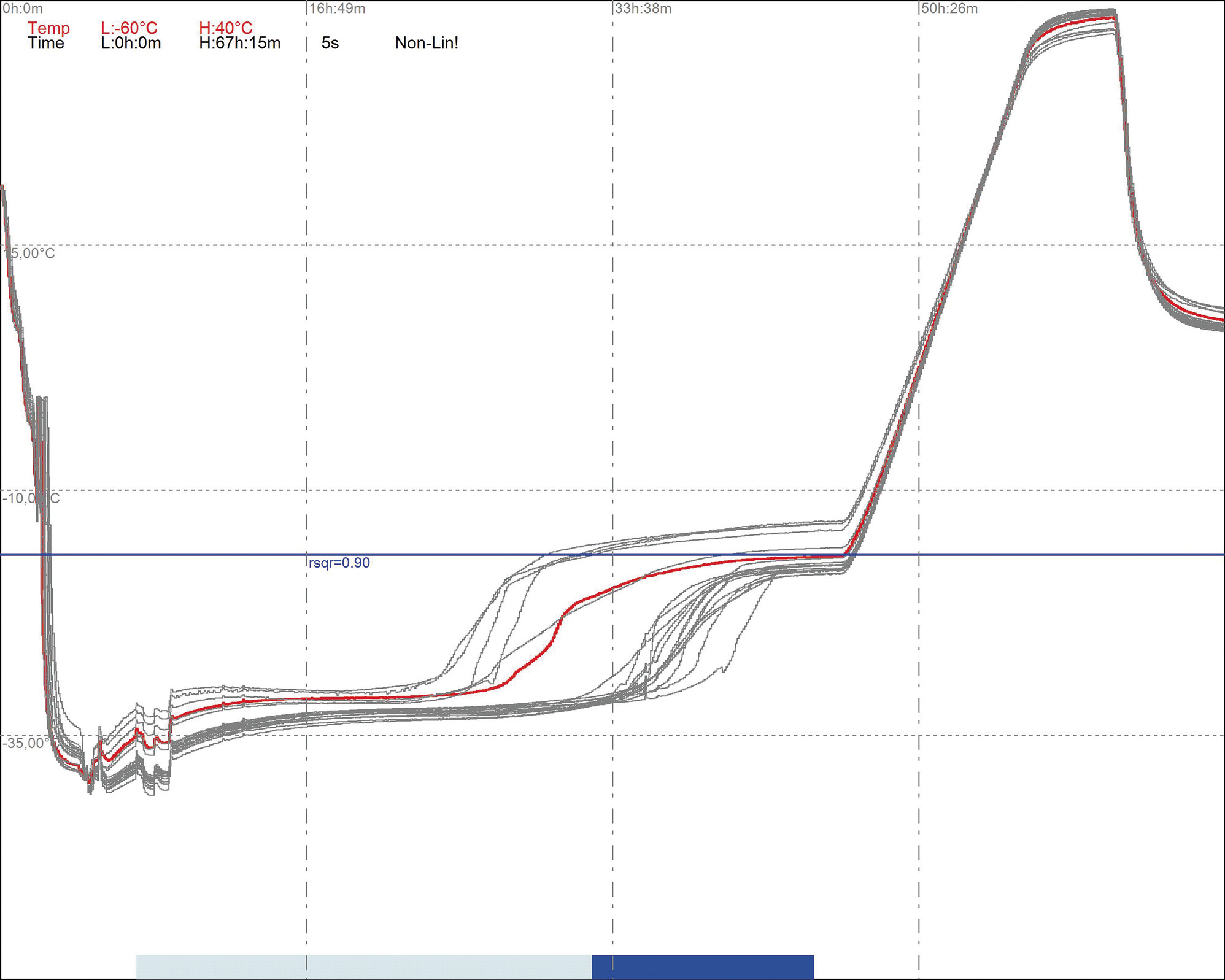
29.10.2026Determination of parameters relevant for lyophilization requires knowledge of the remaining ice mass at the end of the primary drying. Regular lyophilization cycles do not allow taking samples at this stage from vacuum. The secondary drying invalidates samples taken thereafter for the primary drying parameter determination. Radio frequency quartz systems enable reliable product temperature measurement in many samples in production. A novel mathematical model of the individual shelf from product temperature and remaining ice mass calculation is presented, the parameters are optimized by the use of an artificial neural network. Karl Fischer titrated primary drying only runs were used to provide the training data. Statistical evidence of the correlation between prediction and titration is provided. Finally, it is shown how kv and Rp values are derived from remaining ice mass data, thus allowing to constantly monitor these parameters in production runs for a large sample set.
-
Energieeinsparung in Reinstmediensystemen | Beitrag aus pharmind 88 | Nr. 9 | Seite 718-725 (2026)
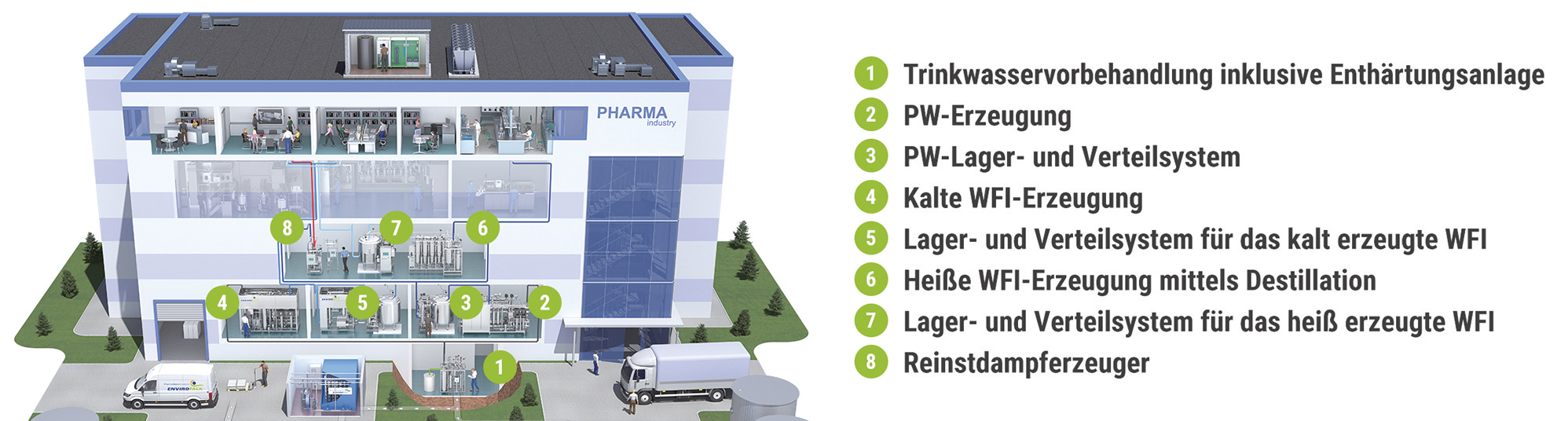
27.10.2026Reinstmediensysteme für Gereinigtes Wasser (Purified Water, PW), Wasser für Injektionszwecke (WFI) und Reinstdampf (RD) verursachen einen erheblichen Anteil des Energieverbrauchs in pharmazeutischen Herstellungsprozessen. Dieser Beitrag zeigt praxisnah, wie durch bedarfsgerechte Planung und optimierte Betriebsweisen Energie- und Betriebskosten nachhaltig gesenkt werden können. Im Fokus stehen typische Planungs- und Betriebsfehler, der Vergleich heißer und kalter WFI-Erzeugung sowie konkrete Maßnahmen zur Optimierung von Ausbeuten, Sanitisierungsverfahren und Anlagenbetrieb. Ziel ist es, wirtschaftliche und regulatorisch sichere Einsparpotenziale aufzuzeigen und dauerhaft nutzbar zu machen.
-
Continuous Manufacturing of Oral Solids | Beitrag aus pharmind 88 | Nr. 9 | Seite 708-717 (2026)
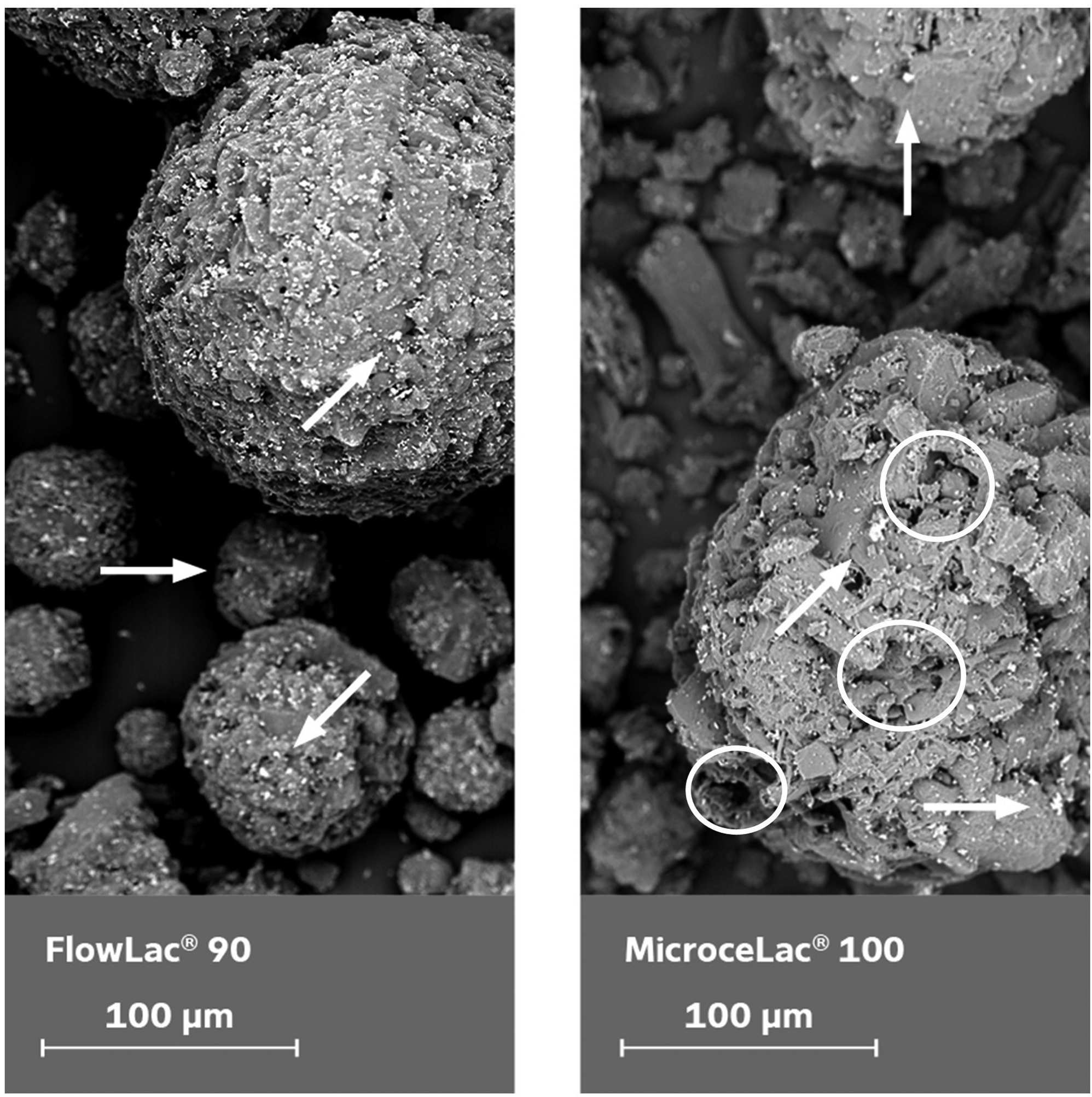
23.10.2026Continuous manufacturing is transforming pharmaceutical solid dosage production, but its success depends on suitable material properties, particularly of excipients. This study shows that co-processed excipients address key limitations of conventional excipients through engineered particle systems that offer superior flowability, feeding consistency, and resistance to segregation. In 5 systematic case studies, co-processed excipients performance was evaluated in relation to continuous direct compression and dry granulation. The results demonstrate reduced feeding variability (<1 % RSD), maintained content uniformity at low Active Pharmaceutical Ingredient (API) concentrations (1 % w/w), robust tablet formation at high drug loads (up to 80 % w/w Paracetamol), low lubricant sensitivity, and dual-compression tolerance enabling continuous dry granulation. Overall, co-processed excipients emerge as critical enablers for effective continuous manufacturing of oral solid dosage forms.
Sie sehen Artikel 1 bis 10 von insgesamt 23493
- Erste Seite
- 1
- 2
- 3
- 4
- 5
- Letzte Seite